Thursday, March 15, 2012

What Grown-Ups Can Learn From Phineas and Ferb

Have you ever watched an episode of the Disney Channel cartoon, Phineas and Ferb? If not, I highly recommend it. It's smart, funny, and manages to tell engaging stories within pretty much the same plot-framework episode after episode - which is indicative, I think, of the creativity and brilliance of the writers. I was introduced to it by my six-year-old son, who asked if he could watch it, and as I often like to work within eye-and-ear shot of my kids, whenever possible, I slowly got exposed - and sucked in - to this clever television show.

I also realized that despite it being an animated series, and therefore able to exaggerate and push the boundaries of "reality" in ways that live-action shows and "real life" obviously can't, there were some very real lessons that we as educators and adults could bear to learn regarding children and learning.
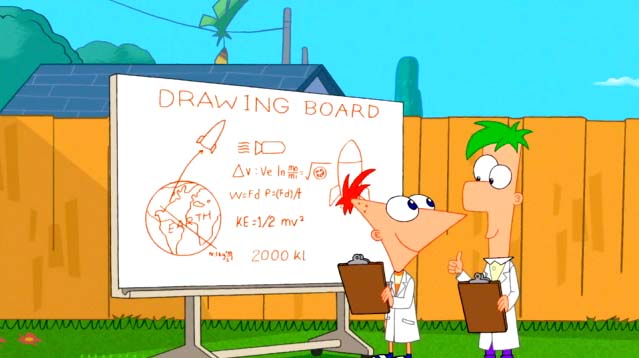
Phineas and Ferb ©Disney


1. Address a Need: At the start of each new "day," or episode, the two title characters look around themselves and ask, "So, what are we gonna do today?" This query is always answered by the identification of some immediate need in their environment or community - a teenaged sister who needs to learn to drive, a challenge to play soccer by some rival peer group, the desire to cool the heat of a summer day with a beach party (even though they're nowhere near a beach), the hope of having something "exciting" to report about their summer vacation once they're back in school, the need to retrieve their mother's lucky guitar pick that has slid beneath the wall, etc. The point is, of course, that each day's endeavor has context. Whatever it is that Phineas and Ferb are working on/playing with, there's always a reason and a point. No one ever asks, "Why do we have to do this," because everyone knows. Even if the answer is simply, "so we can have the best day ever" --> code for "have enormous amounts of fun doing stuff with our friends."

2. Play can also be an opportunity to learn and create: Phineas and Ferb isn't an educational show. Children who are watching it will not learn quantum mechanics, advanced mathematics, or even the finer points of papier-mache (all things that are utilized in various episodes). However, what they may learn is that if you happen to know how to do or make things, endless amounts of fun and adventure are at your fingertips. Educators and adults (excepting those who work with children between the ages of 0-5) are too quick to overlook the relationships between play and learning. The two types of activities often go hand in hand - but educators have long lost the art of integrating learning effectively with play in structured learning environments like classrooms. Why is this, when we all know that play will motivate student participation in ways that no class lecture or homework assignment ever will? Why does education need to feel difficult? The answer, of course, is that it doesn't. It's just how we've made it. The good news is, this is absolutely something we can unmake, if we have the will to do it.

Here are a couple other things to mull over - I truly believe that learning can and should be, in large part, fun. It's not easy, however, to design instruction in that way. It's much easier for teachers to deliver instruction through methods such as lectures, non-contextualized demonstrations, and verbal explanations of abstract theories, concepts, and facts - all methods that have low rates of transmission to students and create situations in which students - and educators! -  start to believe they're not good learners. Who should education be easy for? The students? Or the educators? (I should also add that there are some incredibly gifted educators out there who are already doing this more challenging type of teaching. It's the sad truth, however, that what I described in this paragraph is more indicative of what actually happens in classrooms all over this country.)

Which leads to the next lesson...

3. Fun only happens outside of school: Okay, I admit, this is the message that I'm hoping we can eventually debunk, on a large scale. The entire opening theme song is all about the fact that there are just "104 days of summer vacation," and how the characters have to make the most of them. The entire series takes place outside the context of school, because fun happens outside of school. There are certainly references to school in the series. For instance, the character of Baljeet, a young mathematical wizard, is particularly tied to the rating and reward structures provided by traditional education models, which is played upon to great effect in the episode, "The Baljeatles," when Baljeet has a breakthrough in self-expression, only to use it to express his desire to conform closely to the requirements of the establishment. It's funny, but also jarring. You can listen to the song here [video] (lyrics can be read here).

Again, I wholeheartedly believe that we can and must change these paradigms about school and learning. With millions of children locked inside institutions that may be actively working to make at least thousands of them believe they're bad at learning, maintaining the status quo seems simply unacceptable.

4. Project-based Learning engages diverse learners and brings them together for collaboration: One of the most striking things about this show is its cast of characters. Phineas (the show's charismatic and visionary leader) and Ferb (his introverted and brilliant brother) have a core group of friends who work and play with them daily. This group includes the aforementioned "nerd" Baljeet, a "Fireside Girl," (this world's version of the Girl Scouts) named Isabella, and Buford, the resident bully who regularly harasses Baljeet. Other children come and go, but generally it's these five who carry out whatever project happens to make up the day's adventure. And despite their divergent interests and the way they approach  things according to their own somewhat archetypal world-views, they manage to collaborate positively together in nearly every episode. It's not a real stretch of the imagination, either. The stuff they do (and albeit, these things aren't really possible in the real world) is so interesting and engaging, I'd gladly help work on them. I'm betting you would too.

This is our challenge as educators - to create and design relevant, authentic, project-based learning opportunities and environments that engage all learners and meaningfully build on the individual contributions of each.

5. Age is no obstacle: Phineas and Ferb are constantly being asked (at a rate of almost once an episode - it's a repeated bit) if they aren't too young to be taking on whatever endeavor that day's project happens to be. Their pat answer is, "Yes. Yes, we are." But this answer is 1) obviously incorrect as it's disproved by their successes, and 2) it's an effective strategy to get the "concerned" adults out of the way, by affirming their world view (you know, the one in which kids are incapable of inventing, developing, constructing, designing, or executing anything real) within the context of...well, that world view. We grown-ups have a lot of ideas about what children are or are not capable of doing and learning. Once we sweep aside these preconceptions and assumptions, we may realize that they're less to do with what kids can or can't do, and more to do with how our own thinking limits us as educators - and our kids as learners.

6. Don't forget the autonomy: An important component in all of this, of course, is choice. The kids in this show play and work and create together because they choose to - it is, after all, summer vacation, and this isn't school. There's a whole reservoir of motivation and agency educators could dip into if we could just do a better job of creating learning environments where students feel that they have some voice in what they learn and how they learn. I don't advocate creating a "wild west" situation in the classroom, but it is possible to provide more choices and allow students to engage with material on their own terms, especially if we're able to develop instructional models which focus more on experiential, contextualized learning.

7. Time is of the essence: Not only is summer vacation limited, each day comes to an end. The Phineas and Ferb crew wrap up each project in a day. This is not to say we should do the same with our students. But there's an important lesson in this. Momentum and timing matter. Don't let projects drag on indefinitely without authentic, outcomes-based feedback points and milestones.

Futhermore, with every month and year that ticks by, we continue to lose kids to the drop-out epidemic and the graduation crisis (about 7,200 kids per school day which equals roughly 1.3 million 12th graders not graduating with the rest of their class per year1). It's untenable to have so many young people without employable skills, knowledge, or credentials accruing between the cracks of our school systems.

So, keeping all these valuable lessons in mind, perhaps it's time that we educators and grown-ups of the world try applying them to our own efforts. What better project is there, after all, than figuring out how to make every day of school, "the best day ever," for every one of our students? There's a definite need, and who knows, maybe turning learning into play could be fun. I ask you, "So, what are we gonna do today?"

Monday, March 5, 2012

And On That Note...

"In any moment of decision the best thing you can do is the right thing, the next best thing is the wrong thing, and the worst thing you can do is nothing."
~ Theodore Roosevelt ~

I'm reviving this blog, surely but slowly. There's a whole queue of half-written drafts of posts that I started and never finished, which I'll be working my way through in the next few days. This is in preparation for writing about some work I'm mulling over, regarding digital media and learning and my thoughts on that subject. I know a lot of my readers over at IPoPT are educators, so I'm hoping they'll also weigh in on the conversation. 


Stay tuned!

Saturday, April 9, 2011

John the Chemist

No, this is not a post about illicit pharmaceuticals. ^_-

Before I get into the content of the post itself, I want to apologize for letting so many weeks lapse between this and my last post on this blog. It's been much harder than I initially imagined to find the time to write the kinds of posts I wanted to for this blog, as well as keep up with In Pursuit of Pretty Things. So, I thank you for all hanging in there with me and for your patience, while I figure out how to streamline my workflow and time to accommodate Material Good.

This is the post that probably should have come at the beginning of this blog, laying out what I'm hoping to talk, write about, and discuss with you here. I apologize for the poor sequencing - but I can be impulsive, which means that when I get excited and actually write and finish a post about something, I find myself wanting to publish it right away.

John the Chemist is a guy my husband and I met on an airplane, about eight years ago. He was sitting next to Lawrence (it was one of those 3-seat rows, and I had the aisle seat, and John the Chemist had the window) and we call him "John the Chemist," because he introduced himself to Lawrence as John, then added that he was a professor of Chemistry at a well-known university on the east coast. Something my husband was reading caught the interest of said gentleman, and they struck up a conversation that eventually meandered into a range of metaphysical topics, including what it meant to be human and what they both imagined was the point of it all.

Anyway, to make a long story short, my husband's take-away from that conversation were the three things that John the Chemist suggested as guidelines for living a meaningful, positive, and fulfilled life: 1) love unconditionally, 2) live a spiritual life, and 3) heal inner wounds. At the time, I wasn't that impressed. But with the passing of years, I've come to realize that it's quite possible that these three things pretty much cover all the bases. The way you work on them can be wide and varied and unique to yourself, of course - and I'll be the first to say, that I struggle with all of these things on a fairly regular basis. Still, I think it's worthwhile to make consistent and ongoing attempts to do these things and what's worked best for me over the years is to remain open-minded and embrace uncertainty as fully as possible, as it's the uncertainties that often create possibilities in life.

At any rate, it's likely that some of the things I write about here, on Material Good will explore these (my and maybe yours) uncertainties, attempts, and further questions. So I'm curious - what are your guidelines for living a positive and fulfilled life? Are they at all in line with John the Chemist's?

Wednesday, February 23, 2011

Pro-Pizza (Evidence of a Global Community)

Most of you have probably heard about the giant protests taking place in Madison, Wisconsin, against Governor Walker's bill to strip collective bargaining rights from nearly all public sector employees. They're closing out what I believe is their 8th day of protests, and by the time you read this, have probably settled down to partake of some solidarity pizza.

Madison, WI protesters: image via

Yes, you read that right. Solidarity pizza. Apparently, last Tuesday, 2/15/11, the folks at Ian's Pizza - an establishment that's just a block away from the capitol building, decided to take their end-of-night pizzas - the ones that are left over and would have otherwise been thrown away - to the protesters camping out at the capitol building. The next morning, they received a call from California, from someone who said they'd heard what they'd done and they wondered if they could buy a pizza to be delivered that night. Ian's agreed, and before they knew it, orders started rolling in from around the country and around the globe, from people who wanted to support the protesters with the purchase of a pizza. Orders have come in from nearly every state in the country and from countries including Morocco, France, Denmark, Egypt, Brazil, Singapore, Australia, the Czech Republic, Poland, Russia, the Netherlands, and even Antarctica (!!!).

Image via

Ian's says they've been working "all hands on deck," to get the pizzas made and delivered and that other pizza places in Madison near the capitol have also been handling requests for Solidarity Pizzas. When asked for a statement regarding their position on the issue, they replied that they are "pro pizza." ^_^

I love this story, not because I support public sector employees' rights (though I do), but because it illustrates to me how people can be compassionate and empathetic regardless of where they are and who they are. That someone in Egypt, who arguably has quite a lot to deal with right now, what with the recent revolution and the government-building that's going on over there, would take the time to make an international call and spend the money to send pizzas to strangers in a show of support - well, that's a beautiful thing.

As my favorite late-night talk show host and author, Craig Ferguson might say, this is a terrific example of "the triumph of intellect and romance over brute force and cynicism." It happens.

Ian's on State - in case you wanted to send a Solidarity Pizza.

Saturday, February 19, 2011

Nordstrom and Women of Color

A couple days ago, I was perusing my copy of the Nordstrom February 2011 catalogue, when I noticed an interesting phenomenon: the majority of the photographs in this volume featured models of color. In fact, of the 64 pages (including front and back cover shots) that included photographs of women, 47 of them featured minority women. I did not miss the full page spread noting Nordstrom's support of Black History Month, and the Be The Match Registry (which, by the way, is enormously generous - they're offering to support the cost of adding a new member to the bone marrow donor registry up to $75,000 - more on that in a later post) so the choice of minority models for the February catalogue may have occurred in coordination with that, but I will also say, Nordstrom does seem to make pretty consistent use of diverse models (women of color, as well as plus size models) on their website and in their  catalogues, as a rule, which I've always appreciated.

Nordstrom Catalogue, February 2011, front cover

Equity issues have been on my mind lately, as I recently attended an internal professional development/workshop at work, addressing the challenges faced by African American male students. In the past, I've mostly found myself absorbed with issues of gender equity, seeing as how racial equity issues seem a whole heck of a lot more complicated (to me, anyway), but I'm beginning to realize more and more that these things really go hand in hand. 

Nordstrom Catalogue, February 2011, pgs. 16-17

We women are familiar with the token diversity that plays out on the pages of most retail catalogues - J. Crew is one that comes to mind for me, where there is usually at least one image of an Asian model (those are the ones that pop out at me, because...well, they look like me more than the others), usually in a suit (because we're industrious like that). However, this doesn't really make me feel represented by this company or their catalogues. While recycling the same photos of an Asian model in a suit might be cost effective, and a way to claim that you're addressing diversity in your catalogue/website, it's not the same as making a real and meaningful commitment to racial equity in your company's media.

Nordstrom Catalogue, February 2011, pgs. 47-48

I'm not saying that J. Crew and other retail companies are institutionally racist, but it's not a stretch to say that there may be some structural racism* at play here. Just to illustrate, I took a look at the websites of four retailers I commonly visit - Nordstrom, Anthropologie, J. Crew, and Bloomingdales. Anthropologie's website is slightly different from the others, as most of their garments are photographed on dress forms, but they do have some styling pages that use models. I started counting the number of images that were easily accessed, that used images of models, but decided that the sample was too small to make meaningful comparison to the other three sites. I am, therefore, discounting them from this comparison. I did a count of the models of color used on each retailer's "Womens: Dresses" pages, and as of 3:30 PM PST, 2/17/11, these are the percentages of models of color utilized in each company's website:


Nordstrom had the highest percentage of minority women modeling their products, with 32 of 99 images (just their first page of dresses) featuring minority women. Bloomingdales had 17 of 96 (also their first page, when you clicked on the "view 96 per page" option), and J. Crew had a pretty poor 3 out of 145 (this is when you clicked on their "view all" option - without that option, they would have had zero models of color on their first page of dresses. Note: I did not include any dress form images in the total count of 145 for J. Crew). Now, this was a somewhat unscientific polling, if you will, since I didn't have the census information for the individual models and have no idea how the women personally identify themselves, but I think that's okay, because for the purposes of this type of exercise, it's really what the consumer is perceiving that matters.

So, kudos to Nordstrom - just another reason for me to love this company and spend my dollars there. But what about you? How do you feel about racial equity in the composition of a retailer's media? Do you personally feel under or even over-represented in fashion-related media?

*Structural Racism: The cumulative impact of racism on multiple institutions over time. It encompasses (1) history which lies beneath the surface providing the foundation for white racial advantage, (2) culture which serves to normalize and replicate racist images and ideas, and (3) interconnected institutions and policies that perpetuate and reinforce racial power disparities.