Sunday, September 16, 2012

Daring Greatly (Vocal Awareness)


I've mentioned that I've been studying Vocal Awareness a couple times on my other blog, but felt this one was more appropriate for describing and discussing it more fully. I was first introduced to it this past April, and despite having studied it for nearly five months now, still find it difficult to concisely explain what Vocal Awareness is, as it's got a fairly broad scope. At a very superficial level, it's a method for developing more effective speaking, communication, and should you wish to work on it, performance skills such as singing, acting, and broadcasting. There are specific mechanics, techniques, and practices that Vocal Awareness employs to increase vocal resonance, interpersonal connection, and authentic emotional expression.

But if I'm going to describe it honestly, that's only the tip of the iceberg.

It's also, surprisingly, a method by which to develop your Self (and yes, in case you couldn't tell by my use of the capital "s" in "Self," I'm about to go all new-agey on you now, but that doesn't make this any less truthful or real).

Arthur Joseph, the founder and creator of Vocal Awareness - and my teacher - asserts that Voice is a true reflection of a person's perception of him or herself, and that the manner in which a person engages in the use of their voice - and this includes everything from one's stature, breathing, vibrational qualities of the voice, listening, word choice, and expression - reveals a great deal to others - sends messages that can be positive, negative, or both about how we value ourselves and as a result, impacts how others value us.

Vocal Awareness actually trains the practitioner to be consciously aware at all times of all the elements of speaking/vocalization, which requires a deep level of integration between mind/body/spirit. The Voice is uniquely tied to and accessed by mind/body/spirit or Self and as such can, conversely, be a channel to accessing and developing that very same Self.

The interesting thing is, Vocal Awareness's goal is less to convince others of your power and influence (via vocalization) but yourself  of it. Its techniques and practices actually help you to confront and overcome what Arthur characterizes as "the two greatest fears": fear of abandonment and fear of claiming our own greatness.

For those of you who read my "Squinting Up at the Arena" post on In Pursuit of Pretty Things, I should say that I have a whole new understanding of the notion of "daring greatly," after this past week. At the time I wrote that post, I actually imagined that "daring greatly," was more of a circumstantial thing - that some crisis or opportunity would arise before us, and in daring greatly, we would stand and meet its challenges, engaging whatever came at us with courage and valor. Having completed this past week's study, I now realize that to truly dare greatly, we must embody at all times our own personal Greatness and Power which is rooted firmly in our Love and connection to Source (aka God, the universe, your family, however-you-identify-or-define-your-Source).

Which may sound easy, but once you start poking around inside yourself, trying to get a handle on exactly what that means and what that looks like...well, it's usually not very pretty, at first. What I can say, however, is that if you're able to do it - face your two greatest fears and allow yourself to rise above them - the possibilities are endless. And if nothing else, you learn to really and truly enjoy the company you keep (translation = love, forgive, and really like your Self).

Arthur's clientele is crazy elite (as in all kinds of high-powered executives, politicians, actors, broadcasters, coaches, etc from all over the globe) and I have to tell you that when I first saw the list on his website, I kind of wondered what the heck I was doing, working with someone like this. Today, I can say that while I don't possess as many external markers of status and achievement as those others, I have just as much to offer and have already begun to do it. Whatever it may be. In the meantime, I found that some of these crazy elite and previously intimidating people were not only my classmates at Vocal Awareness trainings, but have also become my friends. I know something has shifted within me, because at the end of this last week, I was able to look around that room of people, and feel that I had been able to contribute to their growth as much as they had contributed to mine.

It was a fantastic feeling. And it's not over yet.

If you're interested, I'll keep you updated here on my Vocal Awareness work and I hope you feel free to ask me any questions you may have regarding it.

As always, thanks for reading!


Sunday, July 1, 2012

Cultivating Creativity


We humans are really very interesting. We are fragile and powerful and tender and harsh; we are creative and destructive and loving and indifferent. We are full of faith and full of reason while being simultaneously skeptical and unreasonable.

We are complicated and complex; wonderful and terrible and marvelous and dull.

All of it makes me wonder, how do we bring more of the good out of us? The creative, tender, loving power? The expansive faith and supportive reason? How do we draw out our complexity and marvelousness, while freeing ourselves from complications?

How do we cultivate the essential geniuses within us - each of us?

It seems to me that we are all born with the capacity to be wonderfully creative. As children - especially in the very early years - our creativity emerged in uninhibited, joyful ways. We sang loudly and often; we danced and ran and jumped for the sheer pleasure of it. We drew and scribbled and told ourselves and each other, stories. We built houses and castles and cars and magical flying machines from blocks and bricks and popsicle sticks and we changed the world with the power of our imaginations - even if only for an hour or a day or ten.


Some of us managed to hang on to that essential and creative part of ourselves as we grew into our adulthoods. But my guess is the vast majority of us did not. Even those of us who were considered "artistic" as children (myself included) have probably allowed this aspect of ourselves to be subsumed by dozens of other claims on our attention and time. For those of us who were never considered creative by conventional standards, the probability that we've prioritized opportunities for creative activity in our lives is even less likely.

But why should we even bother, you might wonder. Why does it even matter? Especially when there are so many other things I have to take care of.

Well, I would have agreed with you just a few short weeks ago. Why indeed?

Going back to my original question about cultivating the essential geniuses within us, I think it matters because I think this - being creative - might be the key or at least a grand step towards finding and freeing the best parts of ourselves. By accessing the clearer, less diluted energies of our child-selves and integrating them with the experience, wisdoms, and insights of our adult-selves, it's entirely possible that we could diminish the amount of fear that traps our minds/hearts/bodies/spirits and allow brighter, purer, better energies and beings to emerge from within us.

And what parts of our lives - our relationships, our work, our plans - couldn't benefit from that?

To be sure, in order for any of this to make sense, you have to be willing to acknowledge that we each have an essential genius within us. And to that end, let me note that the word genius, while commonly associated with a superior intellectual capacity, especially as manifested in some sort of creative activity, also means, "a peculiar, distinctive, or identifying character or spirit" - something which all of us have, should we allow ourselves to embody it. Also, I think it's particularly relevant that the word "genius" comes from the latin, "gignere," which means, "to beget," - essentially to father, produce, or create. 

I'm hoping to chart a path forward to finding and embodying this essential genius - this better, brighter self within me. As one of my teachers, Arthur Samuel Joseph, has said - I'm going to do the Work of embodying my Self. I've decided to start by exercising my creative muscles. I'm not entirely certain where it's going to take me, but I know that when I allow myself to be creative - to happily dabble in dreaming and making and singing and playing, I am brighter, braver, more hopeful. When I flex that part of me, I'm left feeling rejuvenated, refreshed, young.

I truly believe that this - embodying our truest and most essential Selves - will have a material impact on everything we do and everyone we come into contact with, directly or otherwise. In fact, conversely, I'd argue that not embodying our truest and most essential Selves also has a material impact on our activities and those around us - but not necessarily the sort of impact for which we are striving. With this in mind, I'll be starting a series of posts here regarding what I'm learning, what I'm doing as part of my process, and I invite you to join me. 

So, here's a first quick exercise to try:

Find a quiet place to sit and close your eyes. In your mind, think back to happy points in your childhood - the very early years, if you can. Remember what it was like, to be 4, 5, 6 years old. Try to recall the quality of the light, the things you smelled, what it felt like inside that body. Then, think about the kinds of things you did when you were playing and feeling really satisfied - things that you got to choose to do. What were they? Make a list (share them below in the comments, if you like). Think about these activities. Do they still resonate with a part of you? When you think about participating in them again, how do you feel?


Friday, May 25, 2012

On Mess, Process, and Learning

Very recently, I had a chance to learn how to make fire.1 And when I say, "make fire," I don't mean using matches or coals or even flint and steel. I mean, make a fire using nothing but three pieces of wood and a length of rope.

It was awesome. And hard. I have the sore arm and back muscles to prove it.

I worked on learning how to do this with several of my colleagues - all of us with higher degrees, a few of us even sporting Ph.Ds after our names. In spite of our credentials (or maybe because of?), it took over an hour - and the collective efforts of eight very educated people - to start two fires.

We began well. We figured out that we'd need to fit the spindle-shaped piece of wood between the two flat boards, and then turn the spindle to create friction. In order to spin the spindle fast enough, we'd need to wrap the rope around it and pull back and forth on the ends to gain better leverage. We managed to get some smoke going, which excited us. But then, there were set-backs. We somehow dulled the ends of the spindle to the point that it wasn't really spinning that well. Also, we were getting smoke from the wrong end of the spindle. Our rhythm for pulling on the rope was poor - the strokes too short to get good flow on the spindle-turns.

We made adjustments. We discussed and asked questions of each other and tried working in silence. We tried again. And again. And again. And again. We got really, really tired.


image source


I admit that after the third time we'd got an ember going but failed to light the tinder we'd made from some pieces of frayed rope, I felt pretty darn frustrated. Just getting to the point where we could get the wooden spindle smoking against another board to build up some "coal dust" (what I was calling it in my head) and then the ember from that, was hard work. But then, having to ratchet up to the next step and figure out how to get that ember to actually catch on the kindling and transform into a flame felt like another beast altogether. Learning to build a fire took multiple attempts (I lost count after the fifth failed ember), lots of adjustments, some discussion, and no insignificant amount of teamwork.

And when we finally did it? It was exhilarating, gratifying, and satisfying like few things I've ever done.

I tell you this story because it reminds me that learning is messy. It's non-linear, inconsistent, and has ebbs and flows. It required a lot of effort, a good deal of determination and persistence, and considerable flexibility - both of mind and manner. There were little triumphs, many "failures," and definite frustration. We needed not only the time and the room to figure things out and try various strategies, but the opportunity to work at it until it felt right. Part of the "feeling right," had to do with finding out who was good at what, which role was best assigned to which team member. And then, really ramping up on each individual's strengths to contribute to accomplishing the objective: starting a fire.

I know now, that were I ever in a situation that called for it, I have the rudimentary knowledge and ability to get a fire going. I know that it might take me a really long time, but that if I keep working at it, applying what I learned today, I could get it to happen. I feel fairly confident about that, despite - or maybe because of - the amount of time and the many attempts and iterations we made at getting that first fire started - that I can be successful at this venture. And knowing this, I also know, I learned it. I really understood and internalized that process.

All of this makes me wonder, how often does this happen with and for our students in school classrooms?  How often do our education systems give students the space, time, and opportunity, to have and experience truly authentic, messy, engrossing, exhausting, exhilarating learning? Where and when do we find the place in schools, to teach our young people that learning is a process and that "failure" and frustration are integral steps in that process? Chances are the answers to these questions run along the lines of, "rarely," in best case scenarios, and "never" on average.

So, all of that being said, I will also say this: we generally agree that we need to reform and transform our education system. It is and will be a process, much like learning to start a fire. It is and will continue to be a hell of a learning experience for all involved. And here's what I'd like to remind us of, as we develop, iterate, challenge, discuss, adjust, and adapt during and through all of this - let's give ourselves room and time to figure things out and try various strategies - let's provide opportunities to work at it until it feels right.2 And as we do that - let's remember what this has been, is, and will be for us - and provide those things for our students and young people as well. Learning is a process and it's a messy one. Accepting and embracing that as learners will make us far more powerful as educatorsAnd in the end, that is really far more than okay.


1Thanks to Michael Trotta of Sagefire Institute for teaching us how to build fires - and some other very important lessons.
2As I write this, I feel the need to clarify that I am concerned that if we wait too long, we might end up losing an entire generation of students while we figure things out. Timely action and thought is required. But hopefully, not at the expense of necessary time and very necessary thought, if that makes any sense. 

Thursday, March 15, 2012

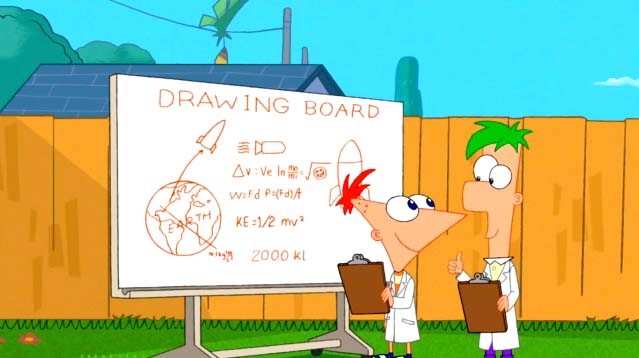
What Grown-Ups Can Learn From Phineas and Ferb

Have you ever watched an episode of the Disney Channel cartoon, Phineas and Ferb? If not, I highly recommend it. It's smart, funny, and manages to tell engaging stories within pretty much the same plot-framework episode after episode - which is indicative, I think, of the creativity and brilliance of the writers. I was introduced to it by my six-year-old son, who asked if he could watch it, and as I often like to work within eye-and-ear shot of my kids, whenever possible, I slowly got exposed - and sucked in - to this clever television show.

I also realized that despite it being an animated series, and therefore able to exaggerate and push the boundaries of "reality" in ways that live-action shows and "real life" obviously can't, there were some very real lessons that we as educators and adults could bear to learn regarding children and learning.

Phineas and Ferb ©Disney


1. Address a Need: At the start of each new "day," or episode, the two title characters look around themselves and ask, "So, what are we gonna do today?" This query is always answered by the identification of some immediate need in their environment or community - a teenaged sister who needs to learn to drive, a challenge to play soccer by some rival peer group, the desire to cool the heat of a summer day with a beach party (even though they're nowhere near a beach), the hope of having something "exciting" to report about their summer vacation once they're back in school, the need to retrieve their mother's lucky guitar pick that has slid beneath the wall, etc. The point is, of course, that each day's endeavor has context. Whatever it is that Phineas and Ferb are working on/playing with, there's always a reason and a point. No one ever asks, "Why do we have to do this," because everyone knows. Even if the answer is simply, "so we can have the best day ever" --> code for "have enormous amounts of fun doing stuff with our friends."

2. Play can also be an opportunity to learn and create: Phineas and Ferb isn't an educational show. Children who are watching it will not learn quantum mechanics, advanced mathematics, or even the finer points of papier-mache (all things that are utilized in various episodes). However, what they may learn is that if you happen to know how to do or make things, endless amounts of fun and adventure are at your fingertips. Educators and adults (excepting those who work with children between the ages of 0-5) are too quick to overlook the relationships between play and learning. The two types of activities often go hand in hand - but educators have long lost the art of integrating learning effectively with play in structured learning environments like classrooms. Why is this, when we all know that play will motivate student participation in ways that no class lecture or homework assignment ever will? Why does education need to feel difficult? The answer, of course, is that it doesn't. It's just how we've made it. The good news is, this is absolutely something we can unmake, if we have the will to do it.

Here are a couple other things to mull over - I truly believe that learning can and should be, in large part, fun. It's not easy, however, to design instruction in that way. It's much easier for teachers to deliver instruction through methods such as lectures, non-contextualized demonstrations, and verbal explanations of abstract theories, concepts, and facts - all methods that have low rates of transmission to students and create situations in which students - and educators! -  start to believe they're not good learners. Who should education be easy for? The students? Or the educators? (I should also add that there are some incredibly gifted educators out there who are already doing this more challenging type of teaching. It's the sad truth, however, that what I described in this paragraph is more indicative of what actually happens in classrooms all over this country.)

Which leads to the next lesson...

3. Fun only happens outside of school: Okay, I admit, this is the message that I'm hoping we can eventually debunk, on a large scale. The entire opening theme song is all about the fact that there are just "104 days of summer vacation," and how the characters have to make the most of them. The entire series takes place outside the context of school, because fun happens outside of school. There are certainly references to school in the series. For instance, the character of Baljeet, a young mathematical wizard, is particularly tied to the rating and reward structures provided by traditional education models, which is played upon to great effect in the episode, "The Baljeatles," when Baljeet has a breakthrough in self-expression, only to use it to express his desire to conform closely to the requirements of the establishment. It's funny, but also jarring. You can listen to the song here [video] (lyrics can be read here).

Again, I wholeheartedly believe that we can and must change these paradigms about school and learning. With millions of children locked inside institutions that may be actively working to make at least thousands of them believe they're bad at learning, maintaining the status quo seems simply unacceptable.

4. Project-based Learning engages diverse learners and brings them together for collaboration: One of the most striking things about this show is its cast of characters. Phineas (the show's charismatic and visionary leader) and Ferb (his introverted and brilliant brother) have a core group of friends who work and play with them daily. This group includes the aforementioned "nerd" Baljeet, a "Fireside Girl," (this world's version of the Girl Scouts) named Isabella, and Buford, the resident bully who regularly harasses Baljeet. Other children come and go, but generally it's these five who carry out whatever project happens to make up the day's adventure. And despite their divergent interests and the way they approach  things according to their own somewhat archetypal world-views, they manage to collaborate positively together in nearly every episode. It's not a real stretch of the imagination, either. The stuff they do (and albeit, these things aren't really possible in the real world) is so interesting and engaging, I'd gladly help work on them. I'm betting you would too.

This is our challenge as educators - to create and design relevant, authentic, project-based learning opportunities and environments that engage all learners and meaningfully build on the individual contributions of each.

5. Age is no obstacle: Phineas and Ferb are constantly being asked (at a rate of almost once an episode - it's a repeated bit) if they aren't too young to be taking on whatever endeavor that day's project happens to be. Their pat answer is, "Yes. Yes, we are." But this answer is 1) obviously incorrect as it's disproved by their successes, and 2) it's an effective strategy to get the "concerned" adults out of the way, by affirming their world view (you know, the one in which kids are incapable of inventing, developing, constructing, designing, or executing anything real) within the context of...well, that world view. We grown-ups have a lot of ideas about what children are or are not capable of doing and learning. Once we sweep aside these preconceptions and assumptions, we may realize that they're less to do with what kids can or can't do, and more to do with how our own thinking limits us as educators - and our kids as learners.

6. Don't forget the autonomy: An important component in all of this, of course, is choice. The kids in this show play and work and create together because they choose to - it is, after all, summer vacation, and this isn't school. There's a whole reservoir of motivation and agency educators could dip into if we could just do a better job of creating learning environments where students feel that they have some voice in what they learn and how they learn. I don't advocate creating a "wild west" situation in the classroom, but it is possible to provide more choices and allow students to engage with material on their own terms, especially if we're able to develop instructional models which focus more on experiential, contextualized learning.

7. Time is of the essence: Not only is summer vacation limited, each day comes to an end. The Phineas and Ferb crew wrap up each project in a day. This is not to say we should do the same with our students. But there's an important lesson in this. Momentum and timing matter. Don't let projects drag on indefinitely without authentic, outcomes-based feedback points and milestones.

Futhermore, with every month and year that ticks by, we continue to lose kids to the drop-out epidemic and the graduation crisis (about 7,200 kids per school day which equals roughly 1.3 million 12th graders not graduating with the rest of their class per year1). It's untenable to have so many young people without employable skills, knowledge, or credentials accruing between the cracks of our school systems.

So, keeping all these valuable lessons in mind, perhaps it's time that we educators and grown-ups of the world try applying them to our own efforts. What better project is there, after all, than figuring out how to make every day of school, "the best day ever," for every one of our students? There's a definite need, and who knows, maybe turning learning into play could be fun. I ask you, "So, what are we gonna do today?"

Monday, March 5, 2012

And On That Note...

"In any moment of decision the best thing you can do is the right thing, the next best thing is the wrong thing, and the worst thing you can do is nothing."
~ Theodore Roosevelt ~

I'm reviving this blog, surely but slowly. There's a whole queue of half-written drafts of posts that I started and never finished, which I'll be working my way through in the next few days. This is in preparation for writing about some work I'm mulling over, regarding digital media and learning and my thoughts on that subject. I know a lot of my readers over at IPoPT are educators, so I'm hoping they'll also weigh in on the conversation. 


Stay tuned!

Saturday, April 9, 2011

John the Chemist

No, this is not a post about illicit pharmaceuticals. ^_-

Before I get into the content of the post itself, I want to apologize for letting so many weeks lapse between this and my last post on this blog. It's been much harder than I initially imagined to find the time to write the kinds of posts I wanted to for this blog, as well as keep up with In Pursuit of Pretty Things. So, I thank you for all hanging in there with me and for your patience, while I figure out how to streamline my workflow and time to accommodate Material Good.

This is the post that probably should have come at the beginning of this blog, laying out what I'm hoping to talk, write about, and discuss with you here. I apologize for the poor sequencing - but I can be impulsive, which means that when I get excited and actually write and finish a post about something, I find myself wanting to publish it right away.

John the Chemist is a guy my husband and I met on an airplane, about eight years ago. He was sitting next to Lawrence (it was one of those 3-seat rows, and I had the aisle seat, and John the Chemist had the window) and we call him "John the Chemist," because he introduced himself to Lawrence as John, then added that he was a professor of Chemistry at a well-known university on the east coast. Something my husband was reading caught the interest of said gentleman, and they struck up a conversation that eventually meandered into a range of metaphysical topics, including what it meant to be human and what they both imagined was the point of it all.

Anyway, to make a long story short, my husband's take-away from that conversation were the three things that John the Chemist suggested as guidelines for living a meaningful, positive, and fulfilled life: 1) love unconditionally, 2) live a spiritual life, and 3) heal inner wounds. At the time, I wasn't that impressed. But with the passing of years, I've come to realize that it's quite possible that these three things pretty much cover all the bases. The way you work on them can be wide and varied and unique to yourself, of course - and I'll be the first to say, that I struggle with all of these things on a fairly regular basis. Still, I think it's worthwhile to make consistent and ongoing attempts to do these things and what's worked best for me over the years is to remain open-minded and embrace uncertainty as fully as possible, as it's the uncertainties that often create possibilities in life.

At any rate, it's likely that some of the things I write about here, on Material Good will explore these (my and maybe yours) uncertainties, attempts, and further questions. So I'm curious - what are your guidelines for living a positive and fulfilled life? Are they at all in line with John the Chemist's?

Wednesday, February 23, 2011

Pro-Pizza (Evidence of a Global Community)

Most of you have probably heard about the giant protests taking place in Madison, Wisconsin, against Governor Walker's bill to strip collective bargaining rights from nearly all public sector employees. They're closing out what I believe is their 8th day of protests, and by the time you read this, have probably settled down to partake of some solidarity pizza.

Madison, WI protesters: image via

Yes, you read that right. Solidarity pizza. Apparently, last Tuesday, 2/15/11, the folks at Ian's Pizza - an establishment that's just a block away from the capitol building, decided to take their end-of-night pizzas - the ones that are left over and would have otherwise been thrown away - to the protesters camping out at the capitol building. The next morning, they received a call from California, from someone who said they'd heard what they'd done and they wondered if they could buy a pizza to be delivered that night. Ian's agreed, and before they knew it, orders started rolling in from around the country and around the globe, from people who wanted to support the protesters with the purchase of a pizza. Orders have come in from nearly every state in the country and from countries including Morocco, France, Denmark, Egypt, Brazil, Singapore, Australia, the Czech Republic, Poland, Russia, the Netherlands, and even Antarctica (!!!).

Image via

Ian's says they've been working "all hands on deck," to get the pizzas made and delivered and that other pizza places in Madison near the capitol have also been handling requests for Solidarity Pizzas. When asked for a statement regarding their position on the issue, they replied that they are "pro pizza." ^_^

I love this story, not because I support public sector employees' rights (though I do), but because it illustrates to me how people can be compassionate and empathetic regardless of where they are and who they are. That someone in Egypt, who arguably has quite a lot to deal with right now, what with the recent revolution and the government-building that's going on over there, would take the time to make an international call and spend the money to send pizzas to strangers in a show of support - well, that's a beautiful thing.

As my favorite late-night talk show host and author, Craig Ferguson might say, this is a terrific example of "the triumph of intellect and romance over brute force and cynicism." It happens.

Ian's on State - in case you wanted to send a Solidarity Pizza.